
WHAT YAGASU CAN DO
- Acting as a project implementer for blue carbon, agroforestry carbon and forest carbon conservation projects through
- pre-finance mechanism and carbon share with international companies.
- Implementing grant projects on climate adaptation, biodiversity conservation, community development, professional training and scientific research, and running CSR programs.
- Distributing grant fund and in kinds to communities that are need an emergency help for disaster relief, education, lack of nutrition and health assistance,environmental improvement and socialactivities.
- Working in collaboration with PT PIL to market green community products and to register carbon certification at national level
WHO WE ARE
Yagasu was established as a Foundation at the Public Notary in Medan on July 17, 2001. We have long-term practical experiences on land-based climate actions that fulfil a unique role – providing innovative space and finance for nature-based solutions on climate mitigation and adaptation, biodiversity conservation and green economic development.
To operate commercial business, Yagasu collaborates with local company PT. Pantai Indah Lestari (PIL). The company roles are to i) facilitate commercial activities that can’t be handled by Yagasu as non-profit organization; ii) support venture capital, business skills and market networks for green community products and services; and iii) build value chain for national and international markets of fishery products (fish, shrimp and crab), mangrove food & beverage, organic batik mangrove, agroforestry products (organic coffee, cacao, etc.) and eco- tourism.


WHAT WE HAVE DONE
We have conducted community base projects on biodiversity conservation, climate mitigation and adaptation, community development since 2001. The ARR on blue carbon- and agroforestry carbon projects are currently implemented in 9 provinces and will be developed in another 11 provinces of Indonesia.
Mangrove carbon conservation has been conducted North Sumatra and Aceh province.

The mangrove and agroforestry ARR projects are conducted in community lands while mangrove conservation is conducted in community and provincial state forests.
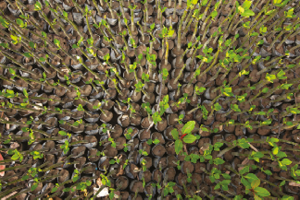
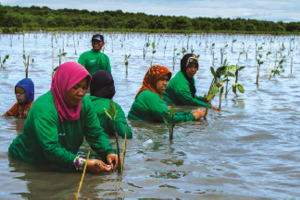
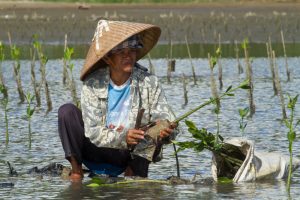
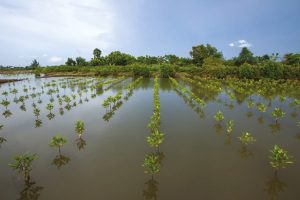


We build a vibrant partnership from various backgrounds who share a common smart vision and culture of cooperation, innovation, and professionalism. We implement sustainable programs at the local level, but it can play an important role on global climate solutions. We pursue this vision through a combination of community training, advocacy, media campaign, policy development, social business, and field project evidence.
We signed legal agreements with Ministry of Village – Republic of Indonesia and each Provincial Government where the projects implemented. Our project operations are mostly conducted in the community lands (non-state forests). Each blue carbon-, agroforestry carbon- and forest conservation project is implemented by local community groups according to the 20 years agreement that was approved by the Village Government.
To implement the long-term program, we consistently follow the international and national regulatory and legal framework of:
- UNFCCC (United Nations Framework Convention on Climate Change) treaty signed in 1992.
- Paris Agreement on Climate Change, adopted in Indonesia in 2015.
- Sustainable Development Goals (SDGs) adopted by the United Nations in 2015.
- Indonesian Law No. 5 Year 1990 about Conservation of Biological Nature Resource and Its Ecosystem
- Indonesian Law No. 5 Year 1994 on Ratification of United Nations Convention concerning Biological Diversity.
- Law No. 32 of 2024 concerning Amendments to the Law on Conservation of Biological Natural Resources and their Ecosystems.
- Presidential Decree No 98 Year 2021 on Carbon Economic of Green-house Gas Program in Indonesia.
- Ministry Regulation No. 12-2024 about Implementation of National Determined Contribution (NDC) in addressing climate change
- IPCC methodology, and other existing national- and international methodologies for carbon certification
Working principle
- Address the priority actions that are urgently needed in the field, where there is a total lack of- or in-sufficient support from other organizations.
- Respect the traditional and local cultural values and remain politically neutral.
- Work through partnerships with individuals and institutions at local, national and international levels.
- Work closely with local stakeholders such as private sector, government, NGOs, and build local capacity as needed.
- Monitor and measure the outputs of each project and activity and adjust the implementation to optimize results.
Strategic program
- Generate GHG emission reductions and removals through i) increased biomass from tree plantation and ii) increased soil organic carbon. The strategy is to mobilize local community groups to restore degraded- and conserve existing coastal- and watershed ecosystems for GHG emission reductions, natural disaster prevention, biodiversity conservation, and sustainable living income.
- Increase ecosystem resilience (soil- and water conservation, and natural disaster prevention); and social economic resilience on sustainable green products.
- Facilitate the presence of unified, inclusive, and active environmental and community development networks; and build shared their local knowledge base.

- Facilitate government policy development and public mandates for the necessary policies and actions to conduct integrated climate change mitigation and adaptation, environmental programs, biodiversity conservation and community development.
- Conduct scientific findings and build partnering networks with global scientists, government, and other local stakeholders on the field programs that are designed to tackle the local problem-solution issues in surrounding project areas and improve the health and welfare of local socio-cultural-economic growth.
- Conduct awareness and facilitation which include the programs and activities to revitalize “the revival” of local community capacity and to build common heritage, identity, and social visions for community development. The target of awareness activities is to establish a more positive external image of local stakeholders that is necessary to attract local, national, and international supports.
- Facilitate income generation of local communities that include sustainable program design, value chain and projects to support the development of social business with climate label of premium organic products.
Our projects are designed to contribute directly to achievement of :
- 💰 SDG 1 – End of Poverty. The increased family income and welfare created by project’s social- and economic resilience will alleviate the poverty level at local level. The project will develop sustainable community social business practices on processing ecosystem base products and services. The community social business will integrate processing, packaging, branding, certificating, and licensing, marketing, promoting products and developing e-commerce. Based on the business feasibility study, the products and services created by this project are very feasible and profitable.
- 🍽️ SDG 2 – Zero Hunger. Our blue carbon-, agroforestry carbon- and climate mitigation projects create the social-economic impacts on food security of fisheries and agricultural products.
- SDG 5 – Gender Equality. Each Yagasu’s project has a component to empower women groups as leading roles of long-term resilience to the impacts of climate change. Their roles are significantly transforming power imbalances that lead to gender in social equality, not only in number people involved but also in spreading locations and scope of activities.
- 💧 SDG 6 – Clean Water. The blue carbon project has an impact to prevent salt intrusion, while agroforestry project has benefit for natural water purifiers, and soil- and water conservation along watershed ecosystem.
- 🌱 SDG 13 – Climate Action – Planting trees on blue carbon- and agroforestry carbon projects take urgent actions as powerful carbon sinks to combat climate change and its impacts.
- 🐠 SDG 14 – Life below water. The ecosystem resilience will secure sustainable productivity of coastal natural resources on high biological productivity and role in the nutrient budget of adjacent coastal ecosystem and support natural biodiversity enrichment and species stock enhancement.
- 🦜 SDG 15 – Life on Land. Our agroforestry carbon and species and habitat conservation give impacts on Climate, Community and Biodiversity (CCB) in which in certain locations create biodiversity hotspots.

