
GHG EMISSION REDUCTIONS
PROJECT OBJECTIVE
The objectives are to restore and maintain coastal- and watershed ecosystem for i) GHG emission reductions through the increased biomass from tree plantation and soil organic carbon; ii) improvement of community resilience to the impacts of climate change; and iii) natural disaster prevention, biodiversity conservation and green livelihood development.

PROJECT ACTIVITIES
The deliverable activities include:(1) land- and social assessment of project sites, (2) Public engagement (3) education and awareness program. (4) capacity building for local communities, (5) nursery works and planting trees, (6) ecosystem conservation; (7) Monitoring, Reporting and Evaluation (MRE), (8) Research & Development (R&D), (9) social-economic supports; and (10) project management and evaluation.
IMPLEMENTATION APPROACH
- Community base activities empowering local communities.
- Scale-up tested models of various activities implemented in program sites.
- Work in collaboration with government institutions, village governments, local NGOs/CSOs and community groups Combine carbon credit certification with CCB, SDG indicator and biodiversity certification.
- Create innovative skills on agroforestry- and mangrove products and services. Foster sustainable green-economic markets at national and international level.
- Catalyze long-term impact beyond carbon investment through sustainable green economy.
BLUE CARBON PROJECT
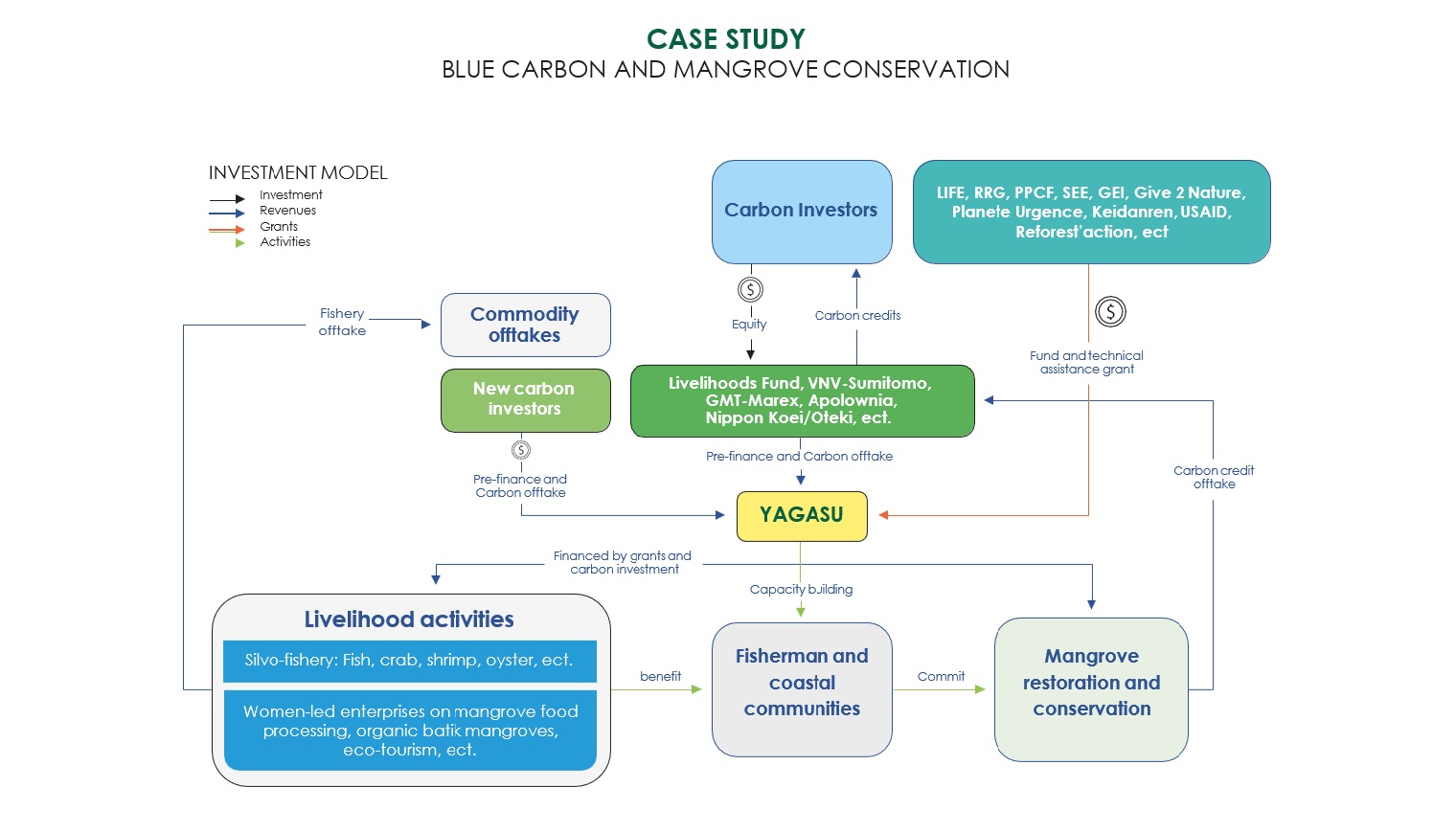
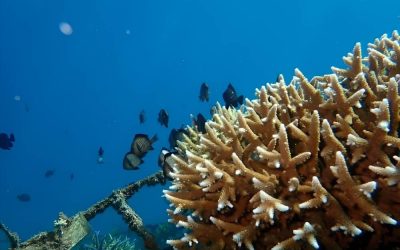
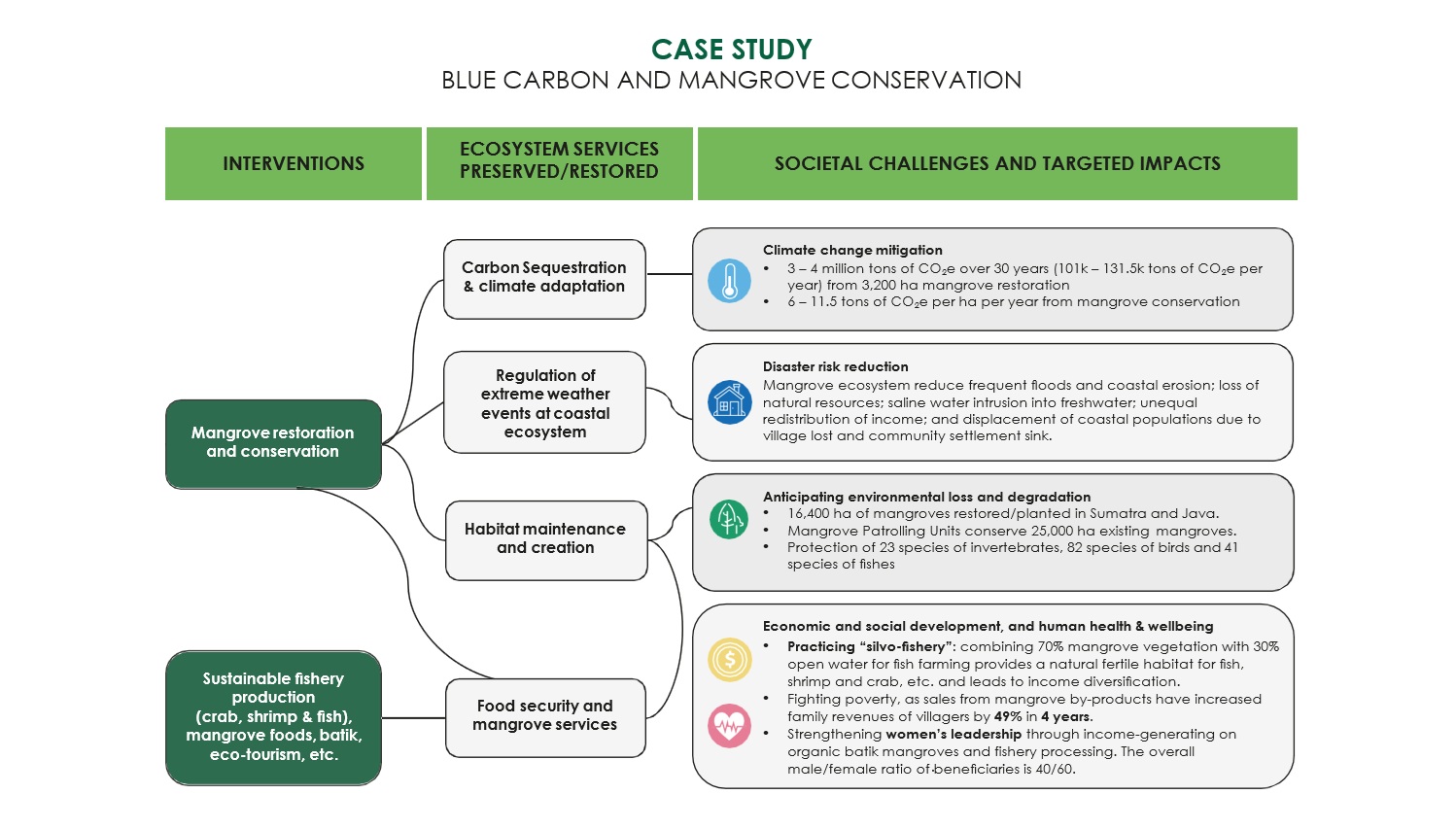
Yagasu conducted mangrove restoration since 2005 to respond tsunami in Aceh and up-to-day has restored 16,400 ha degraded mangroves through grant mechanism and carbon investment. The on-going blue carbon projects are 8,000 ha mangrove restoration in Sumatra and 5,300 ha mangrove restoration in Java. I addition we has also run 25,000 ha mangrove carbon conservation in North Sumatra and Aceh. The blue carbon projects build a Coastal Carbon Corridor that connect the corridor of true mangroves, associated mangroves, seagrass, and coral reef, and they perform an integrated blue carbon ecosystem.
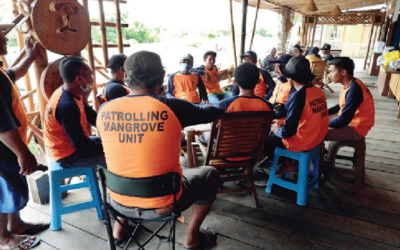
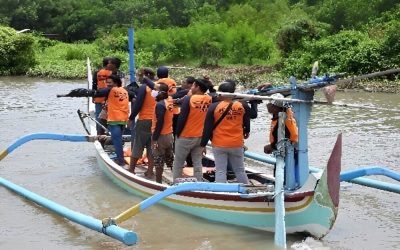
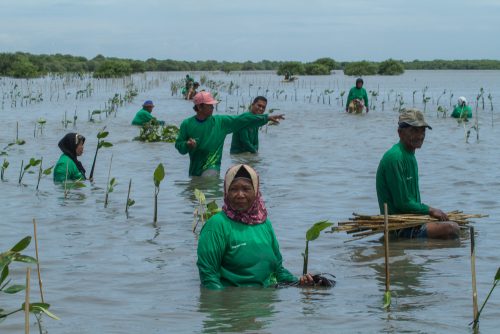
The 1st carbon certification was the Yagasu-Livelihoods Mangrove Project in Sumatra (8,750 ha) by VERRA in 2015. The Yagasu-VNV mangrove carbon project (8,000 ha) was validated by Gold Standard in 2025. More over, the Yagasu-Apolownia mangrove carbon project (3,300 ha) will be listed in VERRA in 2025.
The blue carbon projects create new incomes from fishery products (fish, crab, shrimp, oyster, etc.), organic batik mangrove, mangrove foods/beverages and various house hold women business, and mangrove eco-tourism. The projects also increase adaptation level of local communities from climate change impacts such as sea level rise and coastal abrasion.
PROJECT TYPE
- Verified carbon standard (VCS)on tidal watland of mangrove ecosystem.
- Project impact measurement through Climate Community and Biodiversity (CCB) and Sustainable Development Goal (SDG).
- Further extension of ARR can be combined with conservation of existing vegetation cover at the surrounding of planting sites.
PROJECT SIZE
- 3,200 ha per project cycle, it can be extended into 10,000 ha.
- We committed to provide 10% buffer sites (320 ha) for potential ecological leakage.
- Identified 13,856 ha in Java and 13,625 ha in Sulawesi, and new sites in Sumatra. Land ownership: community lands (non-state forests).
- The use of lands for the project will be stated in the agreements (MoU) between Yagasu and land owners.

PROJECT CERTIFICATION, VALIDATION AND VERIFICATION
VERRA Methodology: apply VERRA – apply VM 0033 methodology on Restoring Wetland Ecosystems (RWE) and Afforestation, Reforestation and Revegetation (ARR). It can be combined with CCB and SDG certification. Gold Standard Methodology: apply Sustainable Management of Mangroves.
This methodology provides the approaches for estimating carbon removals from the reforestation of mangrove ecosystems. This includes the planting of mangroves in areas that historically supported mangrove ecosystems.
SRN PPI certification: apply Tier 3 IPCC Guideline that is a method for calculating GHG emissions using the most detailed equations (modelling and sampling approaches), combined with the diversity of local emission factor approaches in the project sites.


- We use published data or scientific report to generate value for GHG emissions in the same or similar systems on geomorphic, hydrologic, and biological properties, and management regimes as those in the project areas of Indonesia.
- Carbon sequestration is calculated based on the annual growth of vegetation carbon stocks of mix species in pond-, riverbank- and coastline sub-ecosystem + annual SOC evolution.
- Composition of planted mangroves in each sub-ecosystem: pond (15%), coastline (80%) and riverbank (5%).
- The average carbon stocks (2 – 30 years) of mangrove ecosystem in North Sumatra was 344.1 tC ha-1 equivalent to 1,262.8 tCO2e ha-1 (D30 allometry) and 362.0 tC ha-1 equivalent to 1,329.5 tCO2e ha-1 (D30 2H allometry), in which the average SOC stocks (2 – 30 years) was 285.5 tC ha-1 equivalent to 1,047.8 tCO2e ha-1, see Suprayogi et al., 2022.
- Average carbon sequestration (2 – 30 years) of mangrove ecosystem in North Sumatra was 31.5 tCO2e ha-1 yr-1 (D30 allometry) and 41.1 tCO2e ha-1 yr-1
- (D30 allometry), and the SOC was 6,82 tCO2e ha -1 yr-1, see Suprayogi et al., 2022.
- To account allochthonous soil carbon buried at the project sites, the default approach of VCS Methodology VM0033 for Tidal Wetland and Seagrass Restoration is applied . A deduction factor for allochthonous soil carbon for each of the soil layers up to 50 cm measured by Murdiyarso et al., (2015), the SOC sequestration was estimated 3.32 tC ha-1 yr-1 or equivalent to 12.19 tCO2e ha-1yr-1.

- The use of SOC reference from 12.19 tCO2e ha-1 yr-1 (Murdiyarso et al., 2015) compared to 6,82 tCO2e ha-1 yr-1 (Suprayogi et al., 2022) to will significant in crease of annual CO2 removal (5.37 tCO2e ha-1 yr-1).
- Carbon sequestration will in crease significantly when communities can keep an ideal density. An example, when the density in coastline at year 30 increase from 545 to 625 trees/ha (4 x 4 m), there will be an additional CO2e removal 3.14 – 4.31 tCO2e ha-1 yr-1.
The project proponent will decide to select D30 allometry or D30 H allometery, and SOC reference used for carbon estimation written in the PDD. The selected reference should consistently be applied for validation and verification until the end credit period.
- Scenario 1: total VCU if we use conservative value of D30 allometry is 3,037,440 tones CO2-e for 30 years (101,248 tones CO2-e per year).
- Scenario 2: total VCU if we use conservative value of D302H allometry is 3,947,520 tones CO2-e for 30 years (131,584tones CO2-e per year).
- Scenario 3: total VCU if we use SOC Murdyarso is 3,552,960 tones CO2 -e for 30 years (D30 allometry) to 4,271,040 tones CO2 -e for 30 years (D30 2H allometry).
- Scenario 4: total VCU if we use SOC Murdyarso + increase density is 4,238,400 tones CO2-e for 30 years (D30 allometry) to 4,876,800 tones CO2-e 30 years (D30 2H allometry).
- Another potential additional CO2 removal from ARRextension will be from conservation of vegetation cover, seagrass meadow and coral reef at the surrounding mangrove plating sites.
- Project fund will be allocated for a) project preparation and planting action (80%); c) post planting action and social economy for communities (11%); and e) project management (9%).
- If there is any carbon share will be used for field program on replanting the dead trees, tree maintenance, conservation efforts, social economic development, project monitoring, research and project management.
ENVIRONMENTAL RISKS
- Combined permanent floods from mainland and sea-level rise.
- Coastal abrasion due to high wave and sea current and High tidal pattern during monsoon season
- Land-use change of project sites for commercial purposes
- Potential ecological leakage is predicted 10 – 15% during the credit period

